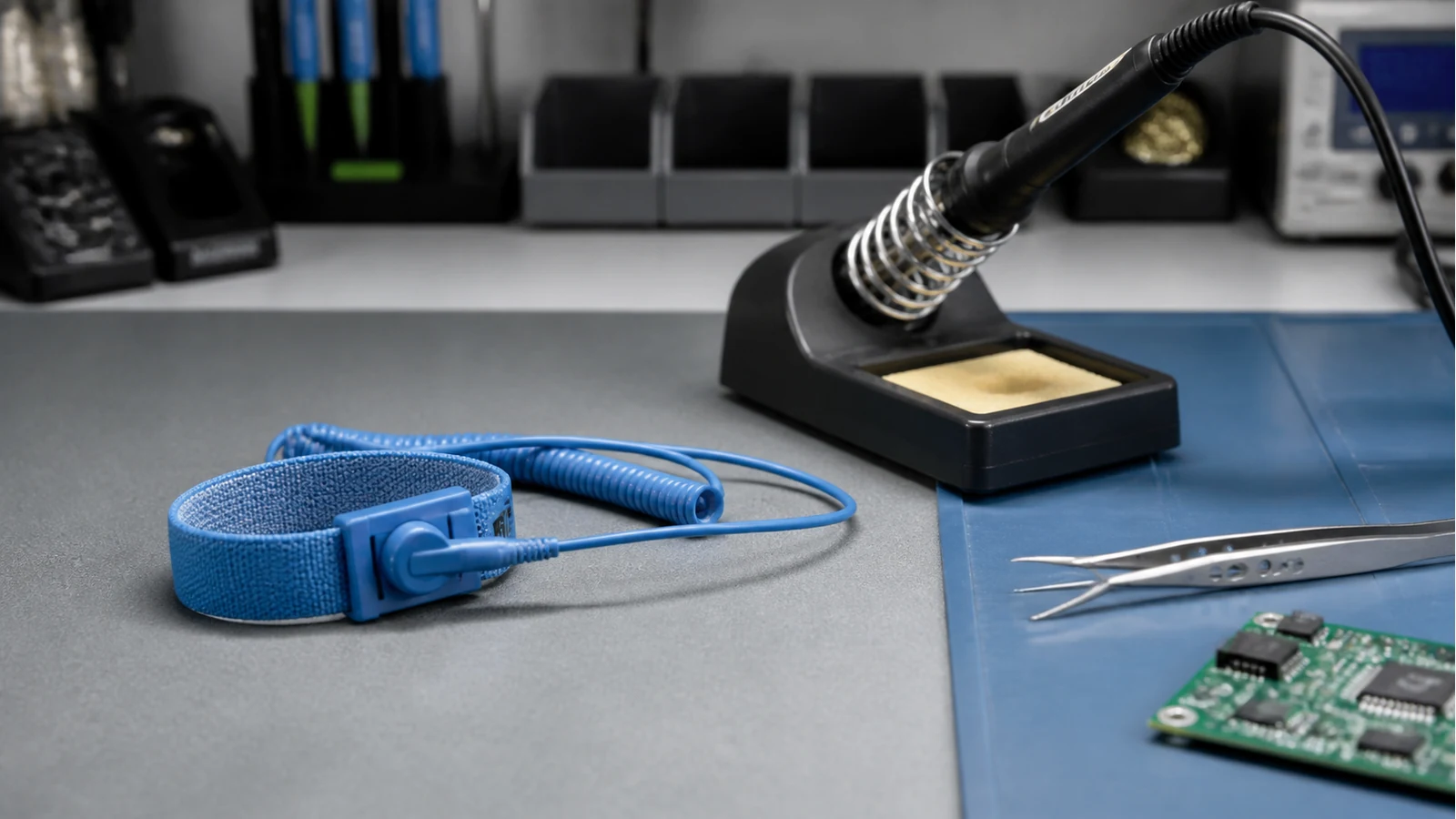
Esd Safe Soldering Station Uk Checklist
Direct answer: an ESD-safe soldering station is only one part of an ESD habit. It usually points to grounded tip paths and ESD-conscious construction, but it does not replace a dissipative mat, wrist strap, grounded bench practice and careful handling of sensitive boards.
For buyers, the safest question is not “does the listing say ESD-safe?” but “what can I verify?” Manufacturer and distributor pages such as the Farnell datasheet and Hakko UK technical page show that serious station documentation can state tip-to-ground values. Those values should be read as product-specific evidence, not copied across to unrelated stations.
What to verify on a listing or datasheet
- Tip-to-ground path: look for published resistance or impedance wording rather than a decorative ESD badge.
- Tip potential: check whether the maker states voltage between tip and ground.
- Stand and handle materials: ESD-conscious accessories help, but they still need the rest of the bench to be controlled.
- Earth continuity habit: the station cannot fix an ungrounded extension setup or careless board handling.
- Scope of claim: a station claim is not the same as a full ESD Protected Area programme.
Who needs to care most
Console motherboard repairers, phone-board repairers, drone-board hobbyists and students learning SMD work should build ESD habits early. Through-hole hobbyists working on simple passive circuits may reasonably prioritise temperature control first, then upgrade the bench habit as their projects become more sensitive.
Do not overread the label
The Kaisertech pro-tool listing illustrates how professional sellers discuss tip-to-ground performance in the context of industry expectations. That does not mean every station sold into the hobby market has the same measured values. If a listing does not publish a value, write “not verified” in your buying notes rather than filling the gap with hope.
For boards that also need hot-air work, pair this checklist with the hot-air nozzle size guide; ESD handling and thermal control fail in different ways.